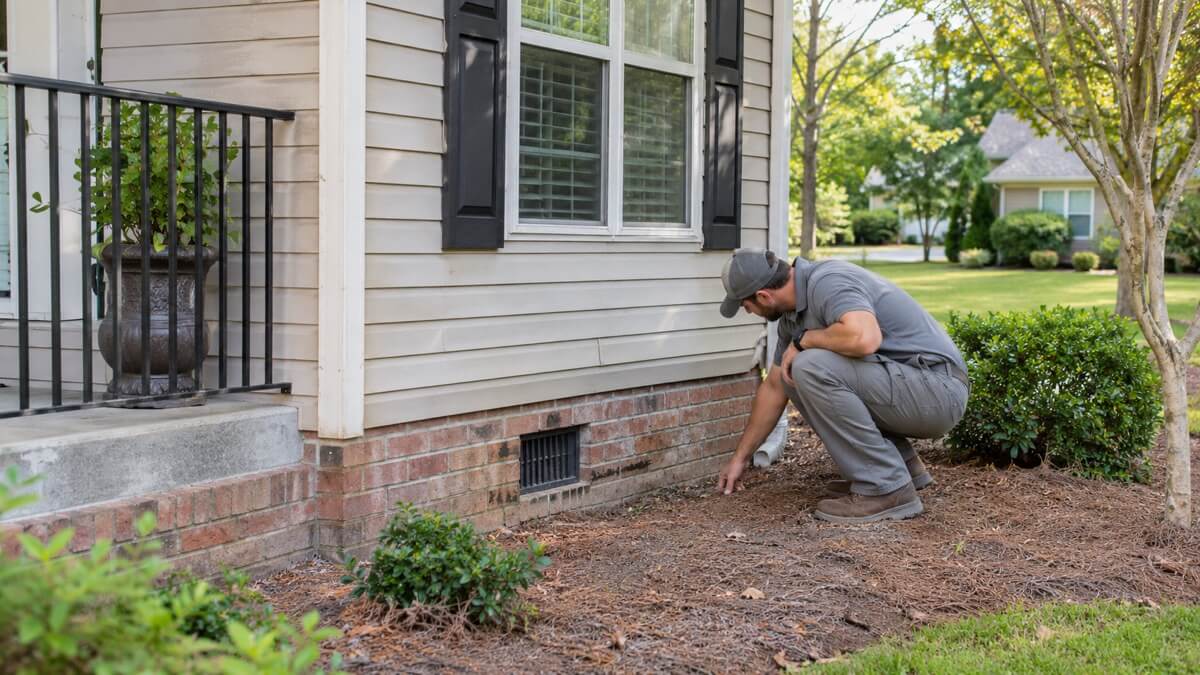
Quick answer: Termite protection and termite damage repairs are priced differently, and costs vary by home and scope. Termites can work inside a structure for months, sometimes years, before visible damage appears. An inspection can help identify activity and explain the available protection or repair options before you decide on next steps.
Termite damage repair costs vary widely. They depend on how long the infestation has gone unnoticed and which parts of the home are affected. Repairs may involve trim, sill plates, framing, subflooring, or other structural components. A qualified contractor must assess the damage and provide a repair estimate. Termite inspection and treatment pricing is quoted separately.
The wide range comes down to timing. Termites rarely announce themselves early. By the time a homeowner notices soft flooring, sagging drywall, or a door that suddenly won’t close, the colony has often been active for a long time. Repair costs climb the longer an infestation goes undetected, which is the strongest argument for prevention over reaction.
"Some of the worst damage I have seen was in homes where the owners had absolutely no idea termites were present. We have opened up walls and found framing that was almost entirely hollow. The wood still looked normal from the outside, but there was nothing left inside. One home in particular had termite activity in the crawl space that had clearly been going on for years. The family had no signs they recognized. No swarmers, no mud tubes they had noticed. By the time we got in there, the repair scope was significant."
Jon Nichols, Service Manager, Bug House Pest Control, Warner Robins
In most cases, no. Standard homeowners insurance policies in Georgia, and across most of the United States, classify termite damage as a preventable maintenance issue rather than a sudden or accidental event. Because of that classification, the cost of repairs typically falls entirely on the homeowner.
This point often surprises homeowners after the fact. A burst pipe is usually covered, but termite damage discovered in the same wall likely is not. Policies differ by carrier and by state, so check your own policy documents or speak directly with your insurance provider to confirm your coverage. The general industry stance, however, is consistent: termites are considered a maintenance responsibility, not an insurable loss.
That gap between what insurance covers and what termites can cost is exactly why proactive termite control works as a form of risk management, not just a service subscription.
Termites are secretive by nature, but they leave behind a handful of signs you can learn to recognize before damage becomes severe.
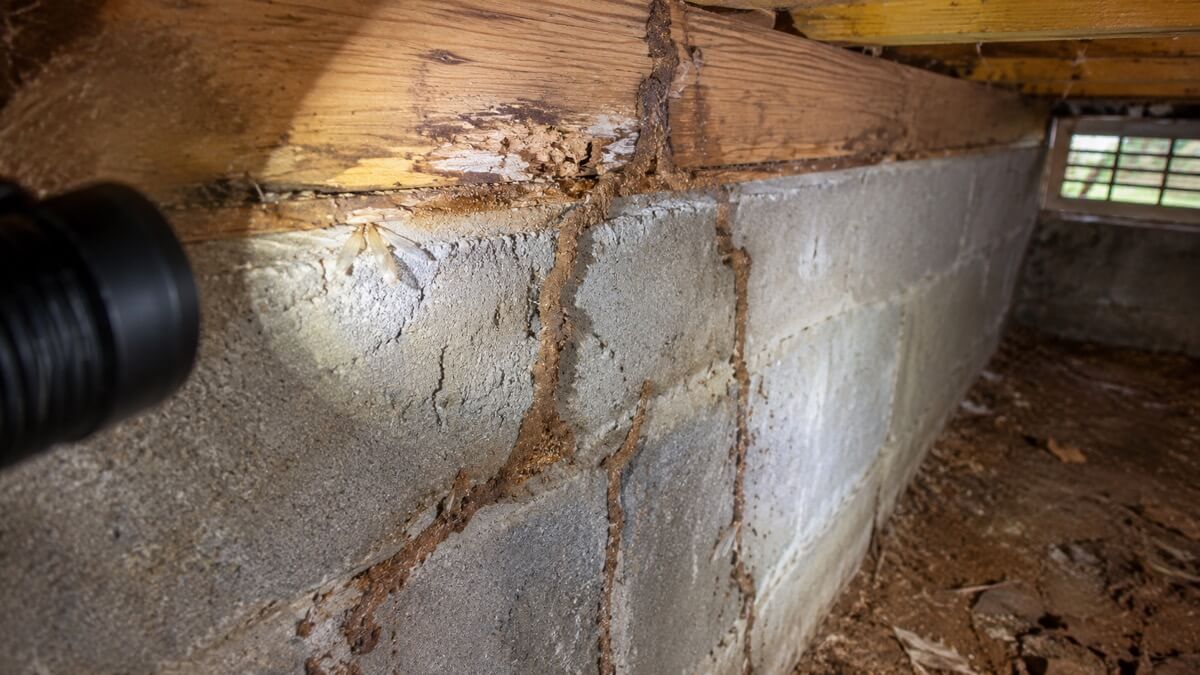
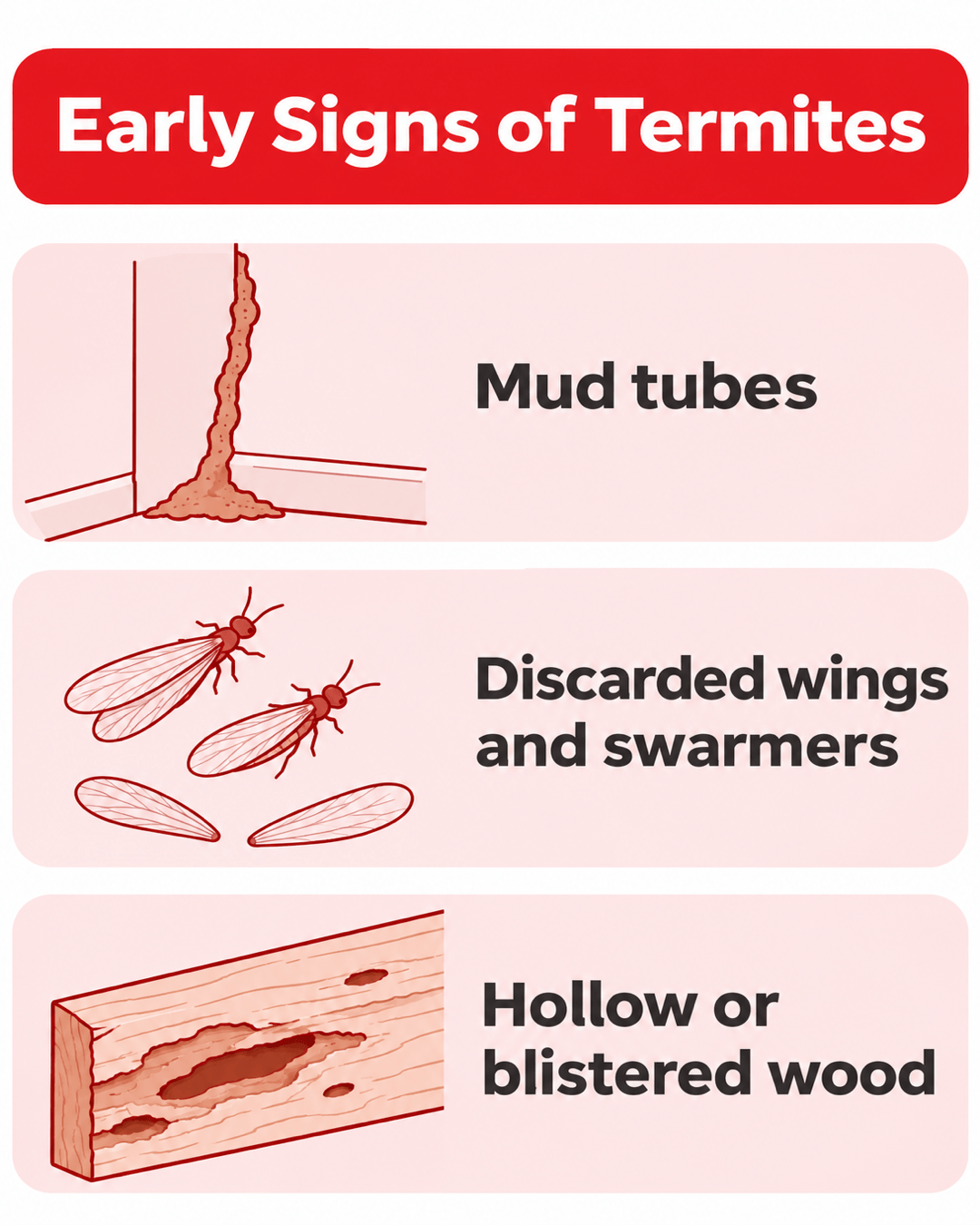
Subterranean termites build pencil-width mud tubes to travel between the soil and the wood they feed on while staying protected from open air and predators. These tubes commonly appear on foundation walls, support piers, or crawl space framing. Finding one is a strong indicator of active termites nearby.
Each spring, mature termite colonies release winged reproductive termites, known as swarmers, to start new colonies. After swarming, these termites shed their wings. A small pile of discarded, uniform wings near a windowsill or door frame is often the first visible clue that a colony is close by, even if the swarmers themselves are gone.
Termites consume wood from the inside, leaving the outer surface intact long after the interior has been hollowed out. Wood that sounds hollow when tapped, or that looks blistered or crushed under paint or veneer, often signals internal damage that has progressed well beyond its earliest stage.
"The one thing I tell homeowners to actually do themselves costs nothing. Grab a flashlight and get in your crawl space at least once a year. Look along the foundation walls and support piers for mud tubes. They look like pencil-thin lines of dried dirt running up the concrete. If you see one, call us. That is the earliest sign most homeowners can realistically spot on their own, and catching it at that stage makes a real difference in what the outcome looks like."
Jon Nichols, Service Manager, Bug House Pest Control, Warner Robins
This is one of the most common questions Georgia homeowners ask. The honest answer is that it depends on the colony, the construction of the home, and how closely the structure is monitored. Termite colonies can feed on a structure for months, and in many documented cases years, before a homeowner notices any visible sign.
"When someone calls us and they have already seen a sign, my first thought is always: how long before this did the activity actually start? In my experience, by the time a homeowner notices something, the colony has typically been active for at least a year, sometimes longer. Crawl space homes are especially vulnerable because nobody is down there looking. We have found cases where we believe termites had been feeding for three or four years before any visible sign reached the living space. That kind of timeline changes the repair conversation significantly."
Jon Nichols, Service Manager, Bug House Pest Control, Warner Robins
This long, quiet feeding period is why termite damage tends to be so costly by the time it’s discovered. Unlike a leak or a fire, there is no single moment that triggers an obvious response. The damage builds gradually inside walls, subflooring, and framing until something visible finally gives way.
Professional termite control is not a single treatment. It is a layered process built around inspection, prevention, and ongoing monitoring.
A thorough termite inspection examines the foundation, crawl space, attic, and any points where wood contacts soil. Technicians look for mud tubes, moisture issues, previous damage, and conditions that make a home more attractive to termites, such as wood mulch against the foundation or poor drainage.
Liquid termiticide applied around and beneath a structure creates a treated zone that termites cannot cross undetected. This barrier approach has been used for decades and remains one of the most common methods for protecting a home’s perimeter from subterranean termites.
Bait stations placed around the exterior of a home offer termites a food source containing a slow-acting active ingredient. Worker termites carry the bait back to the colony, which can reduce or eliminate the colony over time. These stations also serve as an early warning system. Technicians check them on a regular schedule and can catch activity before it reaches the structure.
There is no single public price range for annual termite protection from Bug House. Your quote depends on your home, the treatment method, inspection findings, and the specific service or coverage terms. Ask which inspections, monitoring, retreatments, or other services are included in the written quote.
| Typical cost | Quoted by Bug House based on the home, treatment method, and service terms | Estimated by a qualified contractor after assessing the damage |
| Homeowners insurance | Not applicable (preventive service) | Coverage varies by policy and provider; confirm with your carrier |
| Includes inspection | Yes, scheduled regularly | No |
| Includes damage warranty or bond | Often available; terms vary | No |
| Catches activity early | Yes | No; damage is already present |
"I have had this conversation with homeowners many times. They look at the annual cost of a protection plan and they hesitate. Then I tell them what we found in a house down the street, or what the repair bill looked like on a job we were involved in, and the hesitation usually goes away pretty quickly. The annual cost of a plan is predictable. The cost of finding termite damage late is not, and in my experience, late discovery is far more common than people expect. The math is not complicated once you have seen both sides of it."
Jon Nichols, Service Manager, Bug House Pest Control, Warner Robins
To understand your home’s options, contact your local Bug House team to ask about an inspection and a project-specific quote. Our team can walk you through the findings and any available protection terms.
Some termite protection plans may include a bond or warranty, but coverage, limits, exclusions, and service terms vary. Review the written agreement with Bug House to understand what is covered and whether monitoring or retreatment is included. Ask for the price of each available option as part of your quote.
For homeowners weighing the decision, it comes back to the same comparison covered above: a predictable annual cost versus an unpredictable, often much larger, repair bill that insurance is unlikely to help with.
Most pest control professionals recommend at least one termite inspection per year. Homes in high-risk areas, older homes, and homes with a history of termite activity may benefit from more frequent checks. Georgia’s warm, humid climate is especially favorable to subterranean termites, which is part of why the state ranks among the higher-risk areas in the Southeast for termite activity.
An annual inspection schedule fits naturally with an active protection plan, since most plans already include scheduled visits as part of the service.
Prefer to talk? Call Bug House at 866-696-2001.
Repair costs depend on the location and extent of the damage and the work needed to restore affected materials. A qualified contractor can provide a repair estimate after assessing the home.
Termite protection may help you catch activity earlier, but the cost of a plan and any repairs depends on the property and scope. Ask Bug House what each available plan includes, and compare those written terms with your needs.
Most homes benefit from at least one professional termite inspection per year. Homes in high-risk areas or with a history of termite activity may need more frequent monitoring.
The earliest signs typically include mud tubes along foundations or crawl space framing, discarded wings near windows or doors after a swarm, and wood that sounds hollow or looks blistered.
Most standard homeowners insurance policies do not cover termite damage because it is classified as a preventable maintenance issue rather than a sudden, accidental event. Review your policy or speak with your carrier to confirm your coverage.
Termites can feed on a structure for months, and in some cases years, before damage becomes visible. This long, hidden feeding period is a major reason repair costs tend to be high by the time an infestation is discovered.
Termite protection plans and structural repairs carry different costs, and the total depends on your home and the scope of work. An inspection can help identify activity and explain your options. Review the written service terms and any repair estimate before deciding what’s right for your home.
Talk to a local Bug House termite specialist about protecting your home, and ask about inspection availability, service options, and pricing.
For more guidance on termite identification, inspection, and prevention, see the National Pest Management Association’s termite resources or your regional university extension office.
Author: Ryan I. Adams, Quality Assurance Technical Field Trainer, Bug House Pest Control
Ryan I. Adams is a Quality Assurance Technical Field Trainer for Bug House Pest Control. He works closely with teammates to provide technical training, reinforce industry best practices, and support quality service standards across the Bug House service area. His expertise helps ensure customers receive effective pest management solutions and extraordinary service experiences.
Reviewed by: Cory Goeltzenleuchter, B.C.E., P.H.E., CP-FS
Cory Goeltzenleuchter is a Board Certified Entomologist, Public Health Entomologist, and one of the Southeast’s leading technical experts in pest management. He oversees technical training, service standards, and industry best practices across the Bug House family of brands. His work helps ensure customers receive science-based pest management solutions and extraordinary service experiences.
Subject Matter Expert: Jon Nichols, Service Manager, Bug House Pest Control, Warner Robins
November 12, 2026
August 13, 2026
December 31, 2025
December 17, 2025