Reviewed for accuracy by Anna Vaccaro, Editorial Lead — Pest Education — August 2026
Quick answer: Mosquitoes are drawn to your yard by standing water, body heat, carbon dioxide, and certain scents. Gnats target moisture, decaying organic matter, and overwatered soil. Eliminating standing water, improving drainage, and scheduling professional barrier treatments are the most reliable ways to reduce both pests around your Georgia home.
Mosquitoes do not show up by accident. Every time one lands on you during a backyard cookout or follows you from the garden to the porch, it is responding to a specific set of signals your yard, and your body, are broadcasting. Understanding what those signals are is the first step toward doing something about them.
This guide breaks down exactly what attracts mosquitoes to your yard, why some people get bitten more than others, what draws gnats into the same spaces, and what you can do to make your outdoor areas far less inviting. Bug House service professionals work across Georgia year-round, and what you will find here reflects what they see on the ground in yards from Augusta to Macon.
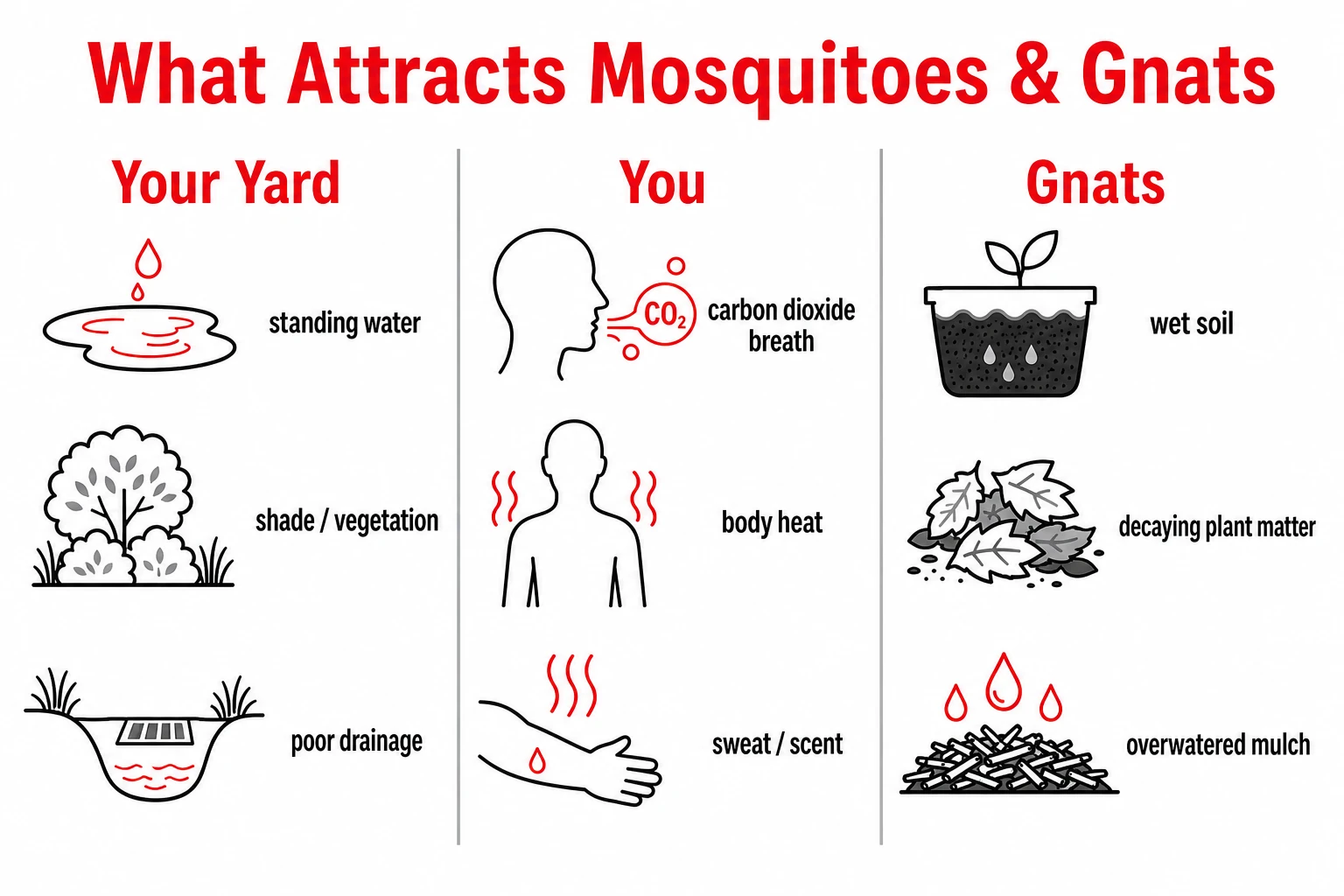
Mosquitoes need water to reproduce. Any standing water on your property, a clogged gutter, a flowerpot saucer, a low spot in the lawn, is a potential breeding site. Adults are also drawn in by carbon dioxide from human breath, body heat, and certain skin compounds like lactic acid and ammonia. Gnats operate differently. They are drawn to moisture in soil, decaying plant matter, and overripe or rotting organic material. The two pests often overlap in the same yards because wet, organic-rich environments support both.
A mosquito only needs about half an inch of standing water to lay eggs. That is a remarkably low threshold, and Georgia’s frequent summer rain makes it easy to meet. Common sources homeowners overlook include:
The connection between standing water and mosquito populations is direct. Remove the water, and you remove the breeding ground. According to UGA Extension, Georgia is home to more than 60 mosquito species, many of which can complete a full breeding cycle in less than two weeks. That means a single neglected container can produce hundreds of new mosquitoes before most homeowners notice the source.
Once adult mosquitoes are in the area, they locate their targets using a combination of chemical and thermal cues. Carbon dioxide from exhaled breath is the primary signal, and mosquitoes can detect it from up to 35 feet away. Body heat and moisture from perspiration amplify that signal at close range. This is why mosquito activity around people feels so personal. It is not random. The pest is following a trail of biological signals your body produces naturally.
Beyond carbon dioxide, mosquitoes respond to compounds found on human skin, including lactic acid, ammonia, and certain fatty acids. Perfumes, scented lotions, and floral fragrances can also attract mosquitoes, particularly species like the Asian tiger mosquito (Aedes albopictus), which is common across Georgia. Dark clothing absorbs heat and makes a person more visible to mosquitoes scanning for warm targets. It is a small factor, but it contributes to the overall picture.
There is no shortage of theories about why certain people attract more mosquitoes than others. Some hold up. Others do not.
“What we see in the field matches the science. Some customers genuinely get hit harder than their neighbors, and it is not just because they are outside more. Body chemistry is real. But what we can control is what is happening in the yard itself.”
A Bug House service professional in Georgia
Gnats are not mosquitoes, but they share enough habitat preferences that many Georgia homeowners deal with both in the same season. The term “gnat” covers a range of small fly species. The two most common in Georgia yards are fungus gnats and eye gnats. Fungus gnats are most common around consistently moist or overwatered soil; they breed in the top layer of soil where organic matter is decomposing, so overwatered lawns, waterlogged garden beds, and planters with poor drainage are prime breeding environments. Eye gnats are more of an outdoor nuisance, attracted to secretions from eyes, nose, and skin, and they tend to swarm faces in warm weather, breeding in loose, sandy soil rather than wet organic matter.
The conditions that attract gnats are distinct from mosquitoes, but they often coexist in the same spaces: overwatered lawns and garden beds, mulch that stays consistently wet, decaying plant material left on the ground, compost piles without proper management, and organic debris under shrubs or in low-lying areas. Reducing gnat pressure often involves the same drainage improvements that reduce mosquito breeding, which is why addressing both together is a practical approach.

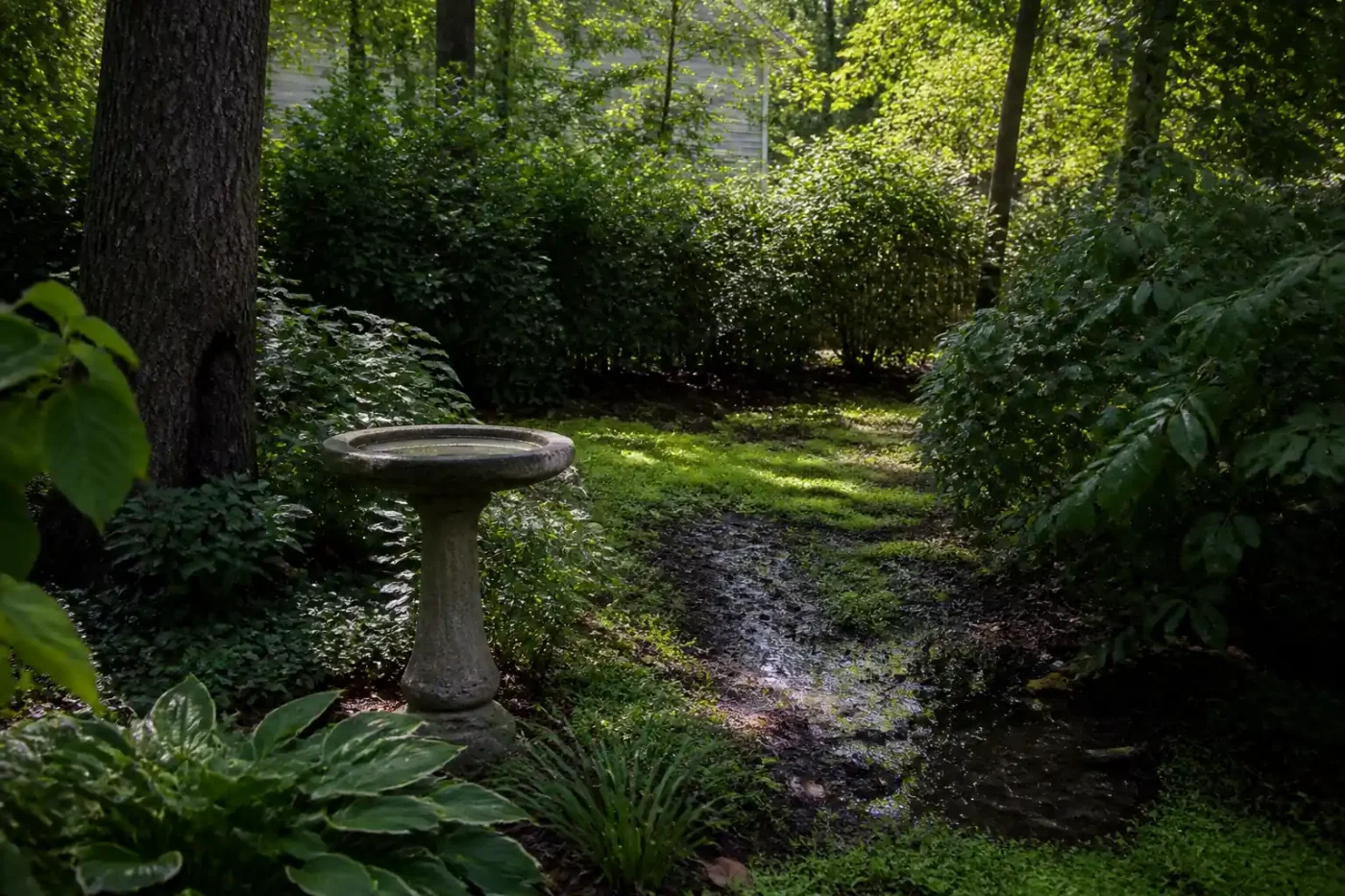
Eliminate standing water consistently. Inspecting your yard after every significant rainstorm is one of the most effective habits a homeowner can build. Clean and flush gutters at least twice a year, more often with significant tree cover; refresh birdbaths every five to seven days; store containers upside down when not in use; fill or grade low spots in the lawn that pool after rain; and ensure ornamental ponds have proper aeration or circulation.
Improve drainage and soil conditions. For both mosquitoes and gnats, drainage is a recurring theme. Yards with compacted soil, poor grading, or overwatered landscaping create persistent moisture conditions that support breeding across the season. Aerating compacted areas, adjusting irrigation schedules, and using well-draining mulch can reduce the micro-environments these pests depend on.
Maintain vegetation. Mosquitoes rest during the heat of the day in dense vegetation, particularly in the shaded undersides of leaves and in tall grass. Keeping shrubs trimmed, mowing regularly, and removing thick ground cover near seating areas reduces resting habitat and makes barrier treatments more effective.
Use EPA-registered repellents for personal protection. When spending time outdoors, especially during peak biting hours in the morning and evening, products containing DEET, picaridin, or oil of lemon eucalyptus are among the options recognized by the CDC as effective.
Property-level prevention goes a long way. But there are situations where professional treatment is the most effective path forward. Barrier spray treatments applied by a Bug House service professional target the areas where adult mosquitoes rest during the day, including shrubs, leaf litter, and vegetation along the perimeter of a yard. Applied on a scheduled basis, these treatments reduce the active population around your home across the entire season.
“We always tell customers that waiting until the problem is obvious means you are already behind. The best results come from consistent, scheduled treatments starting early in the season and maintained through the year.”
Tim Matthews, Bug House, Macon
Contact Bug House to schedule an assessment or get a quote for mosquito treatment at your property. For a full prevention plan, see our guide on how to protect your home from mosquitoes and gnats.
Georgia’s climate creates conditions that are consistently favorable for mosquitoes across much of the year. Warm temperatures, high humidity, frequent summer rain, and a landscape that includes wetlands, retention ponds, drainage corridors, and tree canopy all contribute to an environment where populations can build quickly. The Asian tiger mosquito (Aedes albopictus) is particularly common in Georgia’s suburban neighborhoods. Unlike many species, it is active during the day and often seeks shaded, cluttered outdoor areas, including leaf piles, dense landscaping, and spaces around decks and porches. This species is a container breeder, meaning items that collect standing water can become ideal breeding sites. Yards with both shade and water-holding containers can be especially attractive.
In North Georgia, including the Atlanta metro, the suburban landscape creates localized breeding pressure even in relatively dry conditions. In South and Middle Georgia, including areas around Macon, the combination of heat, humidity, and proximity to water features extends both the season and the intensity of mosquito pressure. Understanding the local biology matters. Bug House service professionals are based in the communities they serve, and the treatments they apply are informed by what is actually driving populations in each area.
August 13, 2026
December 31, 2025
December 17, 2025
December 3, 2025